
Eventi INFN Sezione di Bari
Data
Titolo
Data
Titolo
dicembre
Dettagli dell'evento
E’ indetto un concorso pubblico per titoli ed esame colloquio a n. 1 borsa di studio per attività di formazione ad indirizzo scientifico per neolaureati magistrali da usufruire presso la
Dettagli dell'evento
E’ indetto un concorso pubblico per titoli ed esame colloquio a n. 1 borsa di studio per attività di formazione ad indirizzo scientifico per neolaureati magistrali da usufruire presso la Sezione di Bari dell’I.N.F.N. sul seguente tema di ricerca:
“Quantificazione delle incertezze nei modelli di produzione di trizio nei reattori a fusione”
La durata della borsa di studio è di 12 mesi.
I candidati devono essere in possesso dei seguenti requisiti di ammissione:
– laurea specialistica o laurea magistrale in Fisica
Le domande di partecipazione al concorso devono essere compilate e trasmesse all’INFN per via telematica tramite il sito internet https://reclutamento.dsi.infn.it entro e non oltre il 05-12-2025 entro le ore 23:59:59.
Altro
Orario
21 novembre 202514:07 - 5 dicembre 202514:07(GMT+00:00)
Dettagli dell'evento
Observations of high-energy neutrinos from TeV to PeV with IceCube have ushered in a new era in multi-messenger astrophysics. Notable achievements of the IceCube team include the detection of the
Dettagli dell'evento
Observations of high-energy neutrinos from TeV to PeV with IceCube have ushered in a new era in multi-messenger astrophysics. Notable achievements of the IceCube team include the detection of the diffuse flux of astrophysical neutrinos, identifying two potential neutrino sources associated with supermassive black holes, and observing our own Milky Way galaxy in neutrinos. While much of the neutrino sky remains dark at even higher energies due to the lack of sensitive instruments, observations and theory hint at the rich scientific potential of the very-high-energy (VHE, ranging from PeV to EeV) neutrino sky.
For example, the KM3NET team reported an astonishing event exceeding 100 PeV last year, defying statistical expectations. Or the astrophysical neutrino flux, which does not exhibit signs of a turnover at PeV energies, may extend well into the VHE regime. We also expect VHE neutrinos to originate from the interactions between cosmic rays exceeding EeV and the Cosmic Microwave Background. Finally, an increasing body of literature discusses PeV neutrino emissions near supermassive black holes. Given the abundant scientific opportunities VHE neutrinos present, we are developing the Trinity Neutrino Observatory.
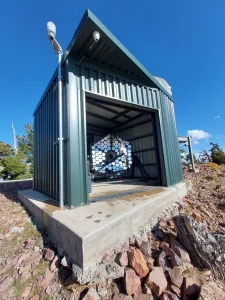
The Trinity Neutrino Observatory employs a system of imaging atmospheric Cherenkov telescopes designed to detect Earth-skimming tau neutrinos from distances of up to 200 kilometers. By carefully selecting the locations of these telescopes, Trinity can achieve full sky coverage with unmatched sensitivity, all at a fraction of the cost compared to other proposed experiments.
In this presentation, I will discuss Trinity’s scientific objectives and share results from the Trinity Demonstrator, which has been operating since the fall of 2023 and serves as a pathfinder for the full observatory. Additionally, I will introduce Trinity One, the first complete telescope of the Trinity Neutrino Observatory, which will be the most sensitive very high-energy (VHE) neutrino instrument aimed at detecting point sources.
Speaker: Prof. Nepomuk Otte – Georgia Institute of Technology
When: 2nd December at 10:00
Where: Aula Multimediale
Altro
Orario
2 dicembre 202510:00 - 12:00(GMT+00:00)
Luogo
Aula multimediale INFN, Dipartimento Interateneo di Fisica, Bari
15dic9:0018:00Bari Theory Xmas Workshop 2025
Dettagli dell'evento
The Christmas Workshop is a traditional appointment of the Bari Theory Group where the various research activities are presented by the youngest members of the group, including those who have
Dettagli dell'evento
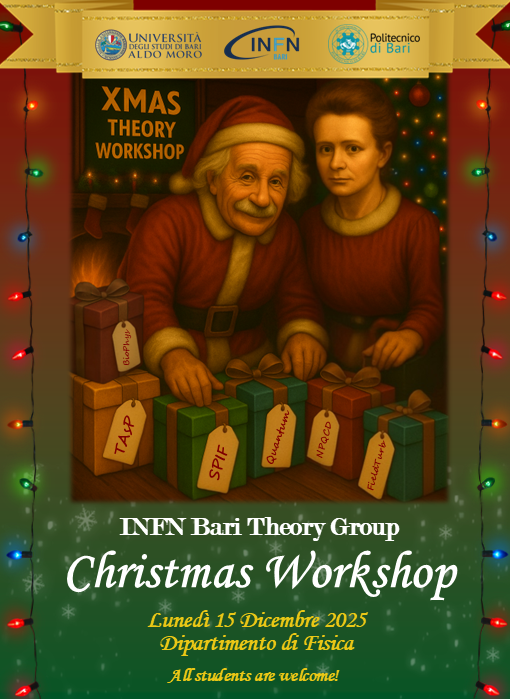
The Christmas Workshop is a traditional appointment of the Bari Theory Group where the various research activities are presented by the youngest members of the group, including those who have been in Bari and are now spending a period abroad.
The framework will be a relaxed atmosphere, the occasion for the new members to fit into the group and for undergraduate students to be informed about the rich panorama of our activities.
All students and members of the Department of Physics and INFN section are welcome.
Contact: Fulvia De Fazio, Stefano Nicotri
More info on Agenda.
Altro
Orario
15 dicembre 20259:00 - 18:00(GMT+01:00)
gennaio
Dettagli dell'evento
Nell’ambito del Progetto “Più Donne nella Fisica” per promuovere la presenza femminile nello studio della Fisica, l’Istituto Nazionale di Fisica Nucleare indice un concorso per soli
Dettagli dell'evento
Nell’ambito del Progetto “Più Donne nella Fisica” per promuovere la presenza femminile nello studio della Fisica, l’Istituto Nazionale di Fisica Nucleare indice un concorso per soli titoli per il conferimento di n. 25 borse di studio per studentesse iscritte al corso di laurea magistrale in Fisica o in Scienze dell’Universo presso Università italiana per l’a.a. 2025/2026 in possesso dei seguenti requisiti:
- Iscrizione e immatricolazione per l’intero anno accademico 2025/2026 al primo anno di un corso di laurea
magistrale in Fisica o in Scienze dell’Universo presso un’Università italiana. - Diploma di Laurea Triennale in un corso di laurea in Scienze e Tecnologie Fisiche conseguita entro il 31 dicembre 2025, con una votazione non inferiore a 100/110 e con una media ponderata di voti degli esami sostenuti non inferiore a 26/30, (la media ponderata è determinata moltiplicando il numero di crediti conseguiti in ciascun esame per il voto ottenuto, mentre per gli esami superati ai quali non è attribuito un voto si considera il voto medio degli esami superati per i quali invece è stato attribuito un voto; la somma dei prodotti ottenuta è divisa per la somma complessiva dei crediti conseguiti).
Il bando è consultabile al link:https://jobs.dsi.infn.it/dettagli_job.php?id=4189
Le domande di partecipazione al concorso devono essere compilate e trasmesse all’INFN per via telematica tramite il sito internet https://reclutamento.dsi.infn.it entro e non oltre il 2 febbraio 2026 entro le ore 23:59:59.
Altro
Orario
1 gennaio 202612:35 - 12:35(GMT+01:00)
febbraio
No Events
Data
Titolo
dicembre
Dettagli dell'evento
Observations of high-energy neutrinos from TeV to PeV with IceCube have ushered in a new era in multi-messenger astrophysics. Notable achievements of the IceCube team include the detection of the
Dettagli dell'evento
Observations of high-energy neutrinos from TeV to PeV with IceCube have ushered in a new era in multi-messenger astrophysics. Notable achievements of the IceCube team include the detection of the diffuse flux of astrophysical neutrinos, identifying two potential neutrino sources associated with supermassive black holes, and observing our own Milky Way galaxy in neutrinos. While much of the neutrino sky remains dark at even higher energies due to the lack of sensitive instruments, observations and theory hint at the rich scientific potential of the very-high-energy (VHE, ranging from PeV to EeV) neutrino sky.
For example, the KM3NET team reported an astonishing event exceeding 100 PeV last year, defying statistical expectations. Or the astrophysical neutrino flux, which does not exhibit signs of a turnover at PeV energies, may extend well into the VHE regime. We also expect VHE neutrinos to originate from the interactions between cosmic rays exceeding EeV and the Cosmic Microwave Background. Finally, an increasing body of literature discusses PeV neutrino emissions near supermassive black holes. Given the abundant scientific opportunities VHE neutrinos present, we are developing the Trinity Neutrino Observatory.
The Trinity Neutrino Observatory employs a system of imaging atmospheric Cherenkov telescopes designed to detect Earth-skimming tau neutrinos from distances of up to 200 kilometers. By carefully selecting the locations of these telescopes, Trinity can achieve full sky coverage with unmatched sensitivity, all at a fraction of the cost compared to other proposed experiments.
In this presentation, I will discuss Trinity’s scientific objectives and share results from the Trinity Demonstrator, which has been operating since the fall of 2023 and serves as a pathfinder for the full observatory. Additionally, I will introduce Trinity One, the first complete telescope of the Trinity Neutrino Observatory, which will be the most sensitive very high-energy (VHE) neutrino instrument aimed at detecting point sources.
Speaker: Prof. Nepomuk Otte – Georgia Institute of Technology
When: 2nd December at 10:00
Where: Aula Multimediale
Altro
Orario
2 dicembre 202510:00 - 12:00(GMT+00:00)
Luogo
Aula multimediale INFN, Dipartimento Interateneo di Fisica, Bari